
How agencies actually run a $1,497/mo managed AI ads service
The operating model behind a single-operator managed ads agency: one LangGraph agent across Meta + Google + TikTok, Discord HITL approvals, 12 ad-ops recipes. The math at 3 clients, the gotchas, the pricing tiers that work.
 Arjun Mehta Lead Engineer · Glitch Grow Catalog
 - AI Ads
- Agency Economics
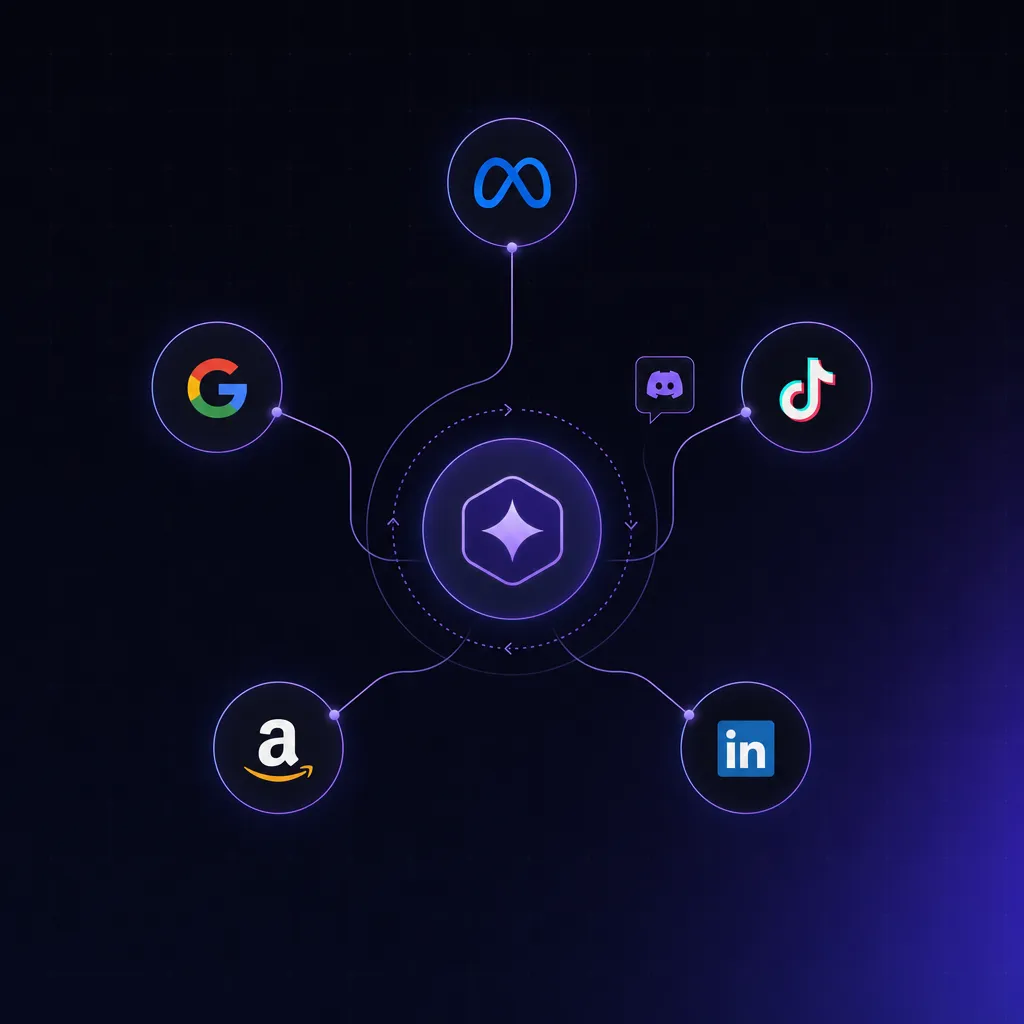
A single operator can run a managed AI ads service for 5–8 clients at $1,497/mo each by deploying one LangGraph-based ads operator wired into Meta + Google + TikTok + Amazon + LinkedIn, with Discord HITL approvals on creative and budget changes. The agent handles plan → analyze → execute → reflect; the human approves the ~10% of actions that need human judgment. Two clients per agent recoups the boilerplate license 10× in the first year.
Why managed ads is the highest-margin AI agency line
Most agencies running ads pay 4 categories of recurring cost: a workflow tool (Zapier or Make), a creative testing tool, a reporting tool (Triple Whale, Polar), and platform fees. That stack runs $300–$600/mo per client before staff time. The operator’s actual leverage is in the agent layer above all that — the part that decides which audiences to refresh, when to rotate creatives, when budgets need a daily-cap bump.
Owning that agent layer is what changes the unit economics. The platform fees and APIs don’t go away — but the recurring software cost drops to one license + infra, and the per-client retainer becomes margin.
What the agent actually does day-to-day
A production ads agent runs a plan → analyze → execute → reflect loop, typically on a 4-hour cron plus event triggers. Each pass:
- Pulls live data from Meta Ads, Google Ads, TikTok Ads, Amazon Attribution, and LinkedIn — through their official APIs, not scraped UI.
- Decides which ad-ops recipes to run. Twelve pre-built recipes cover creative fatigue swap, audience refresh, budget scale-up, budget scale-down, dayparting, lookalike refresh, exclusion list maintenance, bid-strategy swap, and a few others.
- Drafts the action as a structured payload — for example, “swap creative
cre_84forcre_91on adsetas_12because 7-day CTR fell below 0.6%.” - Routes to HITL when the action is above the autonomy threshold for that recipe. Below threshold (e.g., audience refresh), it auto-applies.
- Executes via the platform API after approval (or auto).
- Logs everything with rationale and predicted outcome to Postgres + pgvector — so the next pass can compare actual outcome vs prediction.
The reflect step is what makes the agent different from a workflow runner. A Zapier flow can’t say “I predicted CPC would drop 12% after that audience swap; actual was +3%, so I’ll downweight that recipe for this brand going forward.”
The 12 ad-ops recipes worth shipping with
Recipes are short, testable, opinionated. Each ships with a payload schema, a confidence threshold, and a rollback plan.
| Recipe | When it fires | Autonomy threshold | Typical impact |
|---|---|---|---|
| Creative fatigue swap | 7-day CTR drops below 0.6% on an active creative | HITL after recipe earns 5+ approvals | -8% CPA |
| Audience refresh | Audience saturation > 70% reached | Auto after 3 approvals | -12% CAC |
| Budget scale up | 7-day ROAS > 1.4× target | HITL always (money decision) | +30% revenue |
| Budget scale down | 7-day ROAS < 0.7× target | Auto | Loss prevention |
| Dayparting | Performance variance > 40% by hour-block | HITL | -10% spend, flat revenue |
| Exclusion list maintenance | Duplicate purchaser in audience | Auto | -3% wasted spend |
| Lookalike refresh | Source audience > 90 days old | Auto | +5% match quality |
| Bid strategy swap | CBO underperforming ABO by 20%+ | HITL | Varies wildly |
Eight more recipes ship in the catalog. The point isn’t “the agent has 12 recipes” — it’s that 12 well-scoped recipes cover roughly 80% of the routine optimization moves a senior ad-ops human makes on a daily basis.
Why HITL is non-negotiable
Anyone who has watched an autonomous ads agent spend $4,000 in three hours on a creative that should have been killed knows the answer. HITL isn’t a trust-building exercise; it’s a financial safety mechanism.
The shape that works: every action above an autonomy threshold gets routed to a Discord channel as a one-tap approve/reject/edit message. The operator sees the proposed change, the data behind it, and the predicted outcome. Approval takes 8 seconds. Over time, each recipe earns trust — after 5 consecutive approvals with low-edit-distance, the recipe’s autonomy threshold drops and the agent starts auto-applying that recipe within a daily spend cap.
This is not what Zapier or Make do. Those tools have no concept of per-recipe autonomy thresholds or first-click-wins reconciliation across multiple HITL channels (Discord + Telegram). The Glitch Grow AI Ads Agent ships both.
What “managed AI ads at $1,497/mo per client” actually includes
Pricing is the easy part once the operating model is clear:
- Setup fee. $1,500–$3,000 one-time for account audit + brand-config + first-30-day playbook.
- Monthly retainer. $1,497/mo (US) or ₹25,000/mo (India) covers the agent running across the client’s accounts + weekly reporting + monthly strategy review.
- Add-ons. Custom creative testing pipeline (+$497/mo), ORM monitoring for the brand’s social mentions (+$297/mo), or competitive-spend tracking (+$397/mo).
- Excluded. Ad spend itself (client pays platforms directly), creative production (priced separately or partnered to a UGC pipeline like the AI UGC Agent).
At 3 clients, that’s $4,500/mo in retainer revenue. Infra: a single VM at $80–$120/mo. License: amortized $42/mo over year 1. Operator time: 5–8 hours/week across all 3 clients. Net margin: roughly 85% before owner draw.
Where this model breaks
Three honest caveats:
- Sub-$5K/mo ad budgets. At small spend, there isn’t enough signal for the recipes to fire. You’re charging the client for an agent that mostly just watches.
- B2B with month-long sales cycles. The reflect-on-7-day-CTR loop doesn’t map to B2B lead-gen with 30-day-touch attribution. Build a different pipeline or stay on a human-led model.
- Brands with no creative pipeline. The Creative Fatigue Swap recipe fires constantly; if the brand can’t ship fresh hooks weekly, the recipe degrades into churn.
If any of those describe a prospective client, charge a higher setup fee and run a 30-day fit assessment before committing to a retainer.
Frequently asked questions
Can one operator really handle 5–8 clients?
With HITL automated for ~80% of routine actions, yes. The remaining 20% (budget scale decisions, new audience launches, creative direction) is what the operator’s day actually is. Above 8 clients, you’re hiring a second operator and splitting the deployment by brand-config.
How does this compare to running ads through HubSpot or AdEspresso?
Different category. Those tools are creative testing dashboards. The agent is the layer above — the thing that decides what to test, when to swap, when to scale. Most operators eventually use both.
What’s the realistic ramp from zero to 5 paying clients?
6–9 months for a solo operator with prior ad-ops experience. The first two clients come from existing network; clients 3–5 come from one of: G2 listings, performance case studies, or referrals. Faster than that is rare and usually means undercharging.
Does the agent need to run on the client’s infra or yours?
Yours, on a brand-config-per-client basis. Each client gets a separate brand-config JSON file; the same agent code reads the right one per request. Clients never see your deployment; they see a managed-service.
What happens at the next ad-platform breaking change?
Pull a new version of the agent, run smoke tests against the changed platform, ship. Most platform changes (e.g., Meta’s CAPI updates, Google’s Performance Max API) require a 1–4 hour fix. The boilerplate ships with version-pinned API client libraries and a documented upgrade path.
Further reading
- AI Ads Agent — product page
- Glitch Grow vs Smartlead — the outbound side of the same agency stack
- Buy-once AI agent stacks vs the Zapier + Make + Vapi + Smartlead bill
- Agent Resale ROI Estimator
- Meta Marketing API documentation — primary source
The pitch is straightforward: own the agent layer, price the outcome, let the recipes do 80% of the work. The remaining 20% is what an experienced operator gets paid for.